Welcome to Walter's Maze Mansion! :-)
The computer can make creating and solving Mazes much easier. In addition to
hand made Mazes, I've created many with the assistance of the computer. A few
are quite large, and some have been published in various sources.
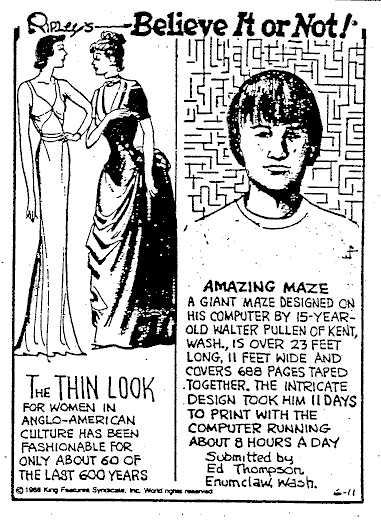
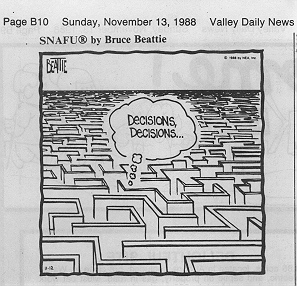
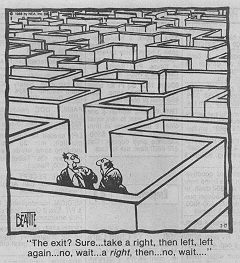
- Ripley's Believe it or Not: I wasn't
on the TV show, but I and one of my Mazes were featured in their cartoon! This
image is scanned from a June 11, 1988 newspaper.
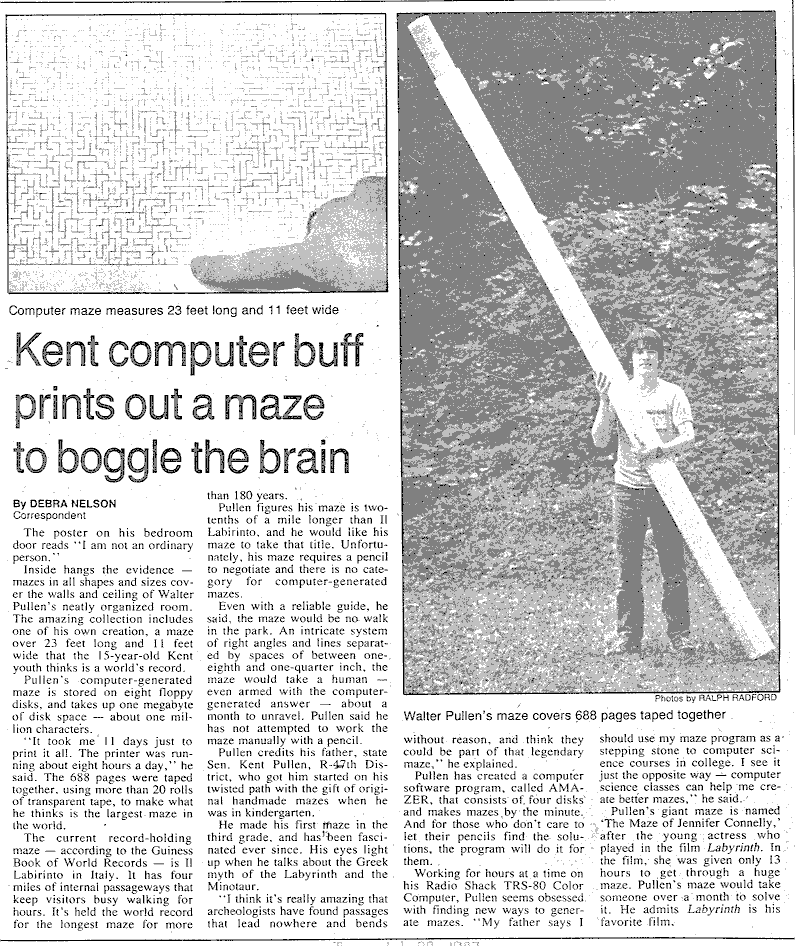
- News article: This is an article from a
local paper about the same Maze featured in the Ripley's cartoon. Yes, I did
name the Maze after the actress. Hey, I was 15 at the time. :-)
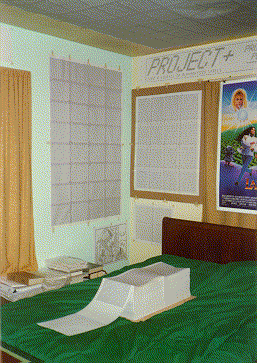
- Even larger Maze: This is a picture
of my room from 1988. The stack of paper on my bed is one long, thin Maze. It's
a continuous stream of paper over a half mile long, where the 3031 pages had to
be spliced together with tape in a few places when reams ran out. The printout
above and to the right is a Maze the same size as The
Maze of Theseus below. The Maze above and to the left is one twice the
size; it's called the Maze of Perseverance, and I created it the weekend before
I saw the movie Labyrinth for the first time. The Maze on the ceiling is called
the Maze of Eternity, and is over five times the size of the Perseverance Maze.
Note also the Escher type room in the corner and the Labyrinth movie poster
over the window.
- The
minotaur quest: Starting in 1991 I played on the MUD Darker Realms, became a wizard, and
put online an area and quest based on the Greek myth of the Minotaur, in which
you get to deal with King Minos, solve the Labyrinth, and face the Minotaur
yourself. (One other MUD I made wizard on was Kerovnia, where my quest there was to
find the secret of the Great Pyramid in Egypt.)
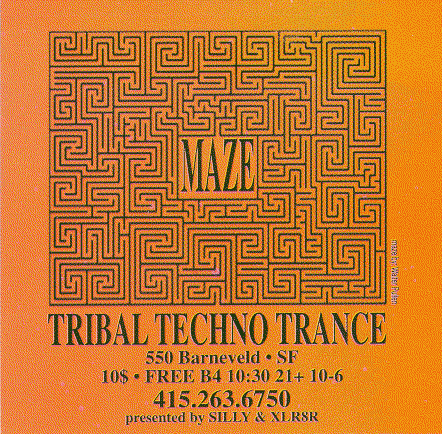
- Maze club: There is a techno music
club in San Francisco called "Maze". I gave them permission to use my
Tangent Maze in this ad card of theirs.
Here is a gallery of Maze graphics. Unless otherwise specified, all of these
were created circa 1990 on a old TRS-80 Color Computer. They're either designed
by hand on the computer, 100% computer generated using one of several Maze
generation programs I've written, or in most cases a mixture of the two. Some
of these images were originally shared on the Usenet group alt.binaries.pictures.misc.
- Sarah Maze: You start outside the Maze,
and your goal is to reach the castle at its center. I manually drew the
boundary, the solution through, and the main blind alleys, then had the
computer randomly fill in the rest. It has 1074 dead ends in it.
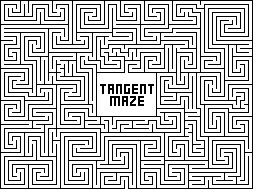
- Tangent Maze: You start outside the
Maze at the bottom, and your goal is to reach the center. This Maze has no dead
ends in it, and is called a purely multiply connected or "braid"
Maze, where all passages are connected with each other in ways designed to run
you around in circles instead of block your way. It's probably harder than it
looks, where the traditional method of following a wall to solve a Maze will
not help here, as you'll just go around in a circle around the center and find
yourself back at the start again! This Maze is 100% hand made, where I planned
it out on paper first, and then drew the finished result on the computer.
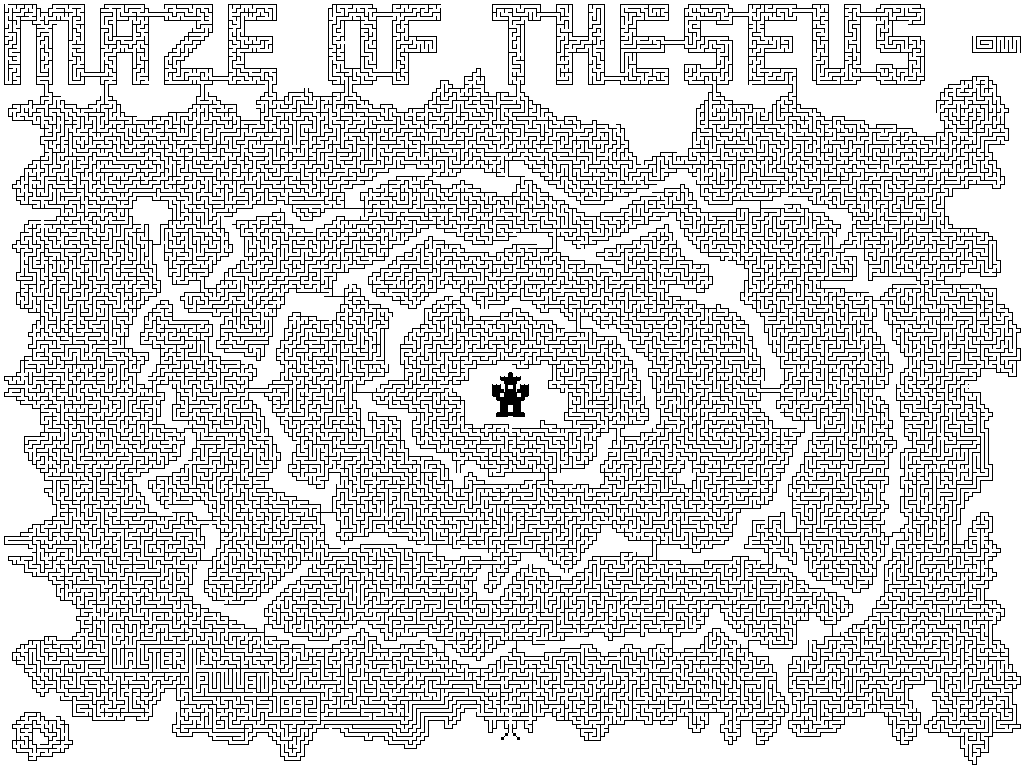
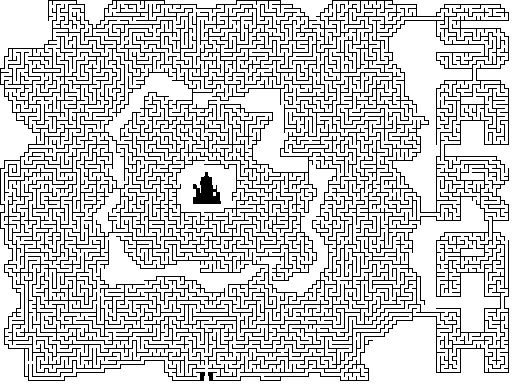
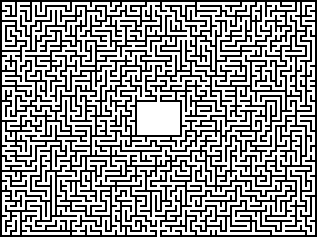
- Maze of Theseus: You start outside
this huge Maze, and your goal is to reach the castle in the open area at the
center. There are three main and obvious entrances, at the south (bottom),
west, and east sides, but if you look closely, there are a number of smaller
entrances around the perimeter as well. I created it in July, 1992. The
boundaries, the solution through, and the main blind alleys, I drew manually,
then had the computer fill in the rest. It has 4296 dead ends in it, and a
number of closed circuits too. This Maze is very hard, and not just because of
its size! It's four times the area of the Sarah and other Mazes here. If it
were life sized (5' passages) it would cover over 1 million square feet, or 20
football fields, and have over 30 miles of passages. Another challenge you can
do once you've reached the center, is to enter through the south entrance, and
try to find a way to the east entrance.
- Lunar Maze: You start outside the Maze,
and your goal is to reach the crescent Moon shaped room at the center. Note the
small "bite" out of the center Moon next to and to the right of the
crescent is not the solution; it's just a dead end, although you can try to
find a way to it too for fun. I created the Maze not long after the Sarah Maze.
The boundary, the solution through, and the main blind alleys, I drew manually,
then had the computer randomly fill in the rest. It has 904 dead ends in it,
and at least half a dozen closed circuits so you can go around in circles some
in addition to bumping into blocks.
- Crack Maze: You start at the entrance
on the left hand side of the Maze, and your goal is to work your way to the
exit at the right hand side. Unlike most Mazes that have right angle passages
arranged on a grid, this "crack" style Maze has walls everywhere at
random angles, with irregular passages between them. It looks much like the
surface of a leaf, and as the smaller and smaller wall segments are only
limited in number by the bitmap resolution, this can be considered a fractal
Maze style too. It's 100% computer generated by one of my programs.
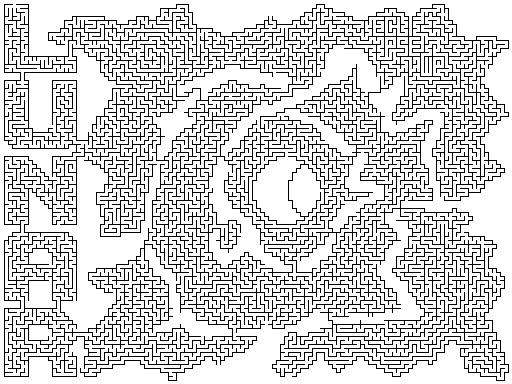
- Unicursal Maze: You start outside at
the upper left corner, and your goal is to reach the exit at the lower right.
This Maze is of a simple and special type called a unicursal Maze, meaning it
has no junctions in it (and no dead ends either). It's just one long snake like
passage running throughout every section of the Maze. It's 100% computer
generated by one of my programs.
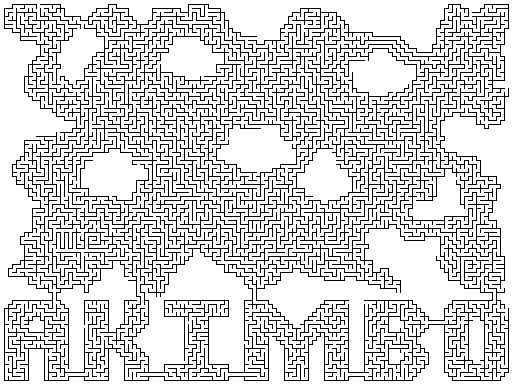
- Akimbo Maze: You start in the open
space at the very middle, and your goal is to reach one of the other four open
spaces surrounding it. (Ignore the two remaining open spaces, at the upper left
and at the lower right, they're just for decoration.) The boundary, the
solution through, and the main blind alleys, I drew manually, then had the
computer fill in the rest randomly. This Maze has a long and involved solution,
and there's a minor trick to it too (it is solvable, where the title of the
graphic is a clue). It has 1024 dead ends in it, and one or two closed circuits
in addition to some isolated unreachable sections.
- British Maze: This Maze is mostly
hand made, where the computer filled in the few remaining areas. Just follow
the instructions, in which I actually consider it a challenging Maze for its
size. This graphic is featured in Cliff Pickover's book "Mazes
for the Mind", page 5. It has 549 dead ends in it.
- Secret pattern: One of the purposes
of a Maze is to cause the ordinary person to get lost, but allow the initiated
to get through it easily. Hence Mazes can have a secret pattern, where if you
know it, you can go through it without error, even if life sized. This is an
ordinary Maze, where you try to reach the center. Its solution has a pattern,
where whenever you have a choice, go left, then right, then right again, and
repeat the pattern until done. I designed the solution, and all nearby passages
to force the pattern, and let the computer fill in the rest. It has 461 dead
ends in it.
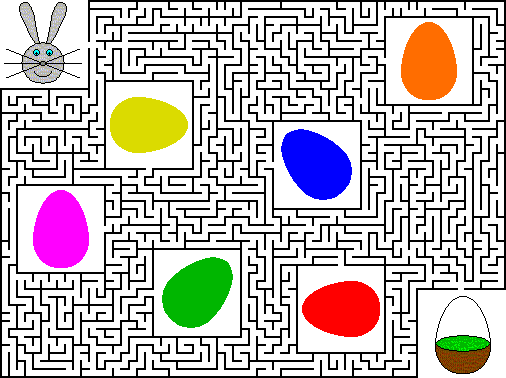
- Easter Maze: Help the Easter Bunny
pick up each of the 6 eggs, then place them in the Easter basket. This is
another Maze where I did the solution and the main dead ends by hand, and let
the computer fill in the rest. It has 222 dead ends in it.
- Hallmark Maze: You start in the room
in the lower left corner, and your goal is to reach the room at the upper right
corner. This is the only Maze in this section I did not design myself. The plan
is from an old Hallmark puzzle, where I manually created this bitmap based on
the puzzle's picture. It is another "braid" Maze with no dead ends in
it.
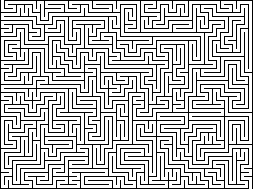
- David Bowie Maze: You start at the
top and finish at the bottom. This is a small Maze, measuring only 29 by 21
passages, but I have it here because it's the picture I included for my entry
when signing the David Bowie
50th birthday card.
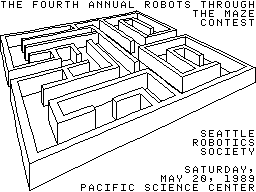
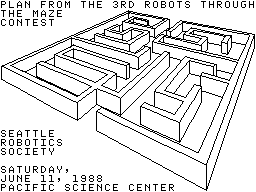
- Seattle Robotics Society Maze: The Seattle Robotics Society has had
contests where member built robots would run through a small wood Maze, seeing
who could make it through in the shortest time. One year I designed the plan
for their Mazes using their available boards, and rendered the plan in a 3D
picture for their newsletter for good measure. Also in that newsletter I wrote
a small article titled What is a Maze. A 3D Maze picture
from another of their contests can be found here.
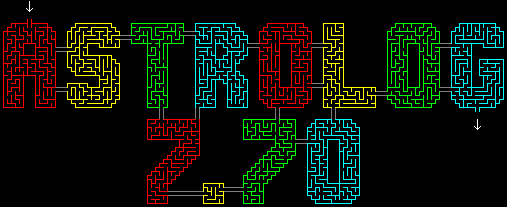
- Astrolog: This is the
Maze that appears at the top of the Astrolog homepage.
I created the outline of it myself, along with the route through and a couple
of the dead ends, and had the computer fill in the rest. Then I manually
colorized it and added it to the Web site.
- Torus Maze: This is a Maze that used to be
the background image for this page. It's a Maze on the surface of a torus,
without a specific start or finish, in which the left and right edges meet and
the top and bottom wrap too. The result is a nice mosaic appearing to be one
large Maze without bounds.
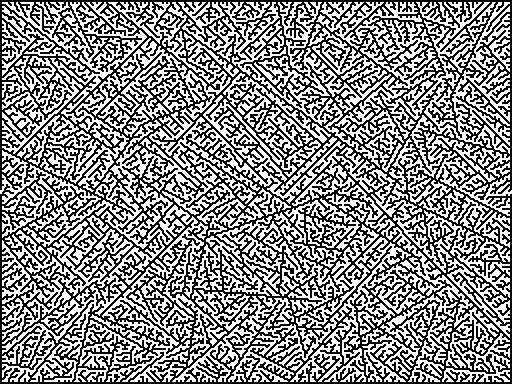
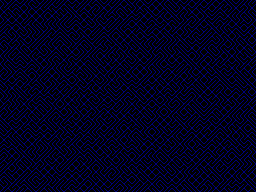
- Tilt Maze: This is the design that
appears as the background for the main Think
Labyrinth page. It's not really a Maze, but just random diagonal lines. It
does however make an interesting pattern of unicursal loop passages.
- Largest Maze on the internet! This
as far as I can tell is the largest, most complicated single file Maze graphic
on the internet today. It measures 16383 by 16383 passages on a 32767 by 32767
bitmap, and has 27213436 dead ends. You start in the upper left and end in the
lower right. The file itself is a 77 megabyte .zip file which unpacks to a 127
megabyte Windows bitmap.
- Larger Maze on the internet: This is
the second largest Maze bitmap on this site, and was formerly the "largest
Maze on the internet". It measures 5000 by 5000 passages on a 10001 by
10001 bitmap, and has 2534438 dead ends. You start in the upper left and end in
the lower right. The file itself is a 7.5 megabyte .zip file which unpacks to a
12.5 megabyte Windows bitmap.
- Large Maze on the internet: This is
the third largest Maze bitmap on this site, and was another former
"largest Maze on the internet". It measures 2884 by 2884 passages,
and has 842900 dead ends. Note that even this smaller file is so large (3.3
megabyte .gif) your browser may not have enough memory to display it, in which
case you may need to download the file and display it in some other graphics
program. :-)
Links to downloadable Maze creation programs or algorithm files.
- Maze Creator Software:
Features the Maze Creator shareware program by Greg Peatfield.
- Maze Maker:
Download a program to create and solve Mazes in various ways, including a first
person view, by Larry Blake.
- MazeFest:
Maze generation shareware program featuring 3D Mazes and first person views.
- 3D Virtual Maze: Maze
generation free trial featuring creation, solving, and color first person
views, by Ataspec Software.
- One Gram Mazes:
A selection of Maze generation shareware programs by One Gram Software,
featuring hexagonal, circular, over and under, symmetric, and amorphous Mazes.
- WedgeSoft Maze:
Create and solve Mazes, including views that only show explored or nearby
passages.
- MazeWorks:
Race the computer through Mazes, and automatically create Maze levels for the
old game DOOM too.
- Threshold: Create and
try to navigate Mazes in up to seven dimensions in this shareware program.
- 4D Maze home page:
Create and try to navigate Mazes in up to four dimensions in this freeware
program.
- 4D Maze Game: Four
dimensional Mazes rendered as perspective stereograms, by John McIntosh.
- Mazecast:
Create and solve Mazes, including a texture mapped first person view, with C
source code available. Older versions of Maze programming are here.
- TorqMaze:
A Maze making and solving program written in the C# language, with source code
available, by Wiktor Zychla.
- Maize Quest:
Free program where you try to solve a Maze with the highest scoring path.
Upload your scores to compare with others. Part of the larger corn Maze site here.
- Dungeon Generator:
Create random dungeon Mazes online or offline, with source code available, by
Jamis Buck.
- Maze Builder:
Download a Windows executable to draw and move through Mazes of definable
sizes, by David Fotland.
- Daedalus: Last but not least, Daedalus is
an extensive Windows program I wrote to create, solve, analyze, view, and walk
through Mazes.
Links to other Maze related downloads such as game levels or algorithm
files.
- Maze
generation FAQ: A pkzip archive of a text file giving computer
algorithms on how to create Mazes. A local copy of the file may be downloaded here, and an already unzipped version may be read here.
- Maze displays: Analyze
Maze passages and walls in brilliant rainbow colorings and tilesets, by Jan
Thor.
- Obfuscated Mazes:
About an implementation of Eller's Algorithm in a very compact and obfuscated
form, by John Tromp.
- Algorithms at edepot:
An implementation of "tilt" mazes and a shortest path algorithm, by
Po-Han Lin.
- Maze Quake
level: The Hampton Court hedge Maze as a level for the game Quake.
- Maze
DOOM level: A .WAD file for the old game DOOM with a Maze theme. Its
description may be read here.
- Escher
room level: Escher staircase room like from the movie Labyrinth as a
level for the game Serious Sam.
- Meca
Software's Maze: Review of a Windows CD-ROM program about Labyrinths
and Mazes.
- Betamaze alphabet:
A description of an alphabet formed of Maze cells where text can form a Maze,
by Terrana Cliff.
- Shortest Path: Research paper
about creating and simultaneously solving Mazes created with recursive
division, by Ciprian Habuc.
- ExcelMaze: Maze
creation, solving, and a first person view in an Excel document I wrote, as
hosted on Excel Games.
Links to sites allowing dynamic creation of random Mazes, where often you
can interactively solve them too.
- Paul Falstad's Maze: Java
first person view Maze solver with smooth animation, color, internal rooms, and
automap.
- 3D Mazes in Java:
Create and solve rectangular and hexagonal Mazes from a perspective overview,
by Jimmy Dean. Also see his Maze on Mars, a
wallpaper graphic image for Windows 95/NT.
- Amazeing: Create and solve random
Mazes in a wide variety of algorithms, by Ijee.
- Maze
applet: A Java Maze applet that generates random Mazes and allows you
to arrow your way through them, by Eric Harshbarger.
- Maze
Maker Home Page: Create and display random Mazes in three different
shapes, by John Lauro.
- Create a Maze:
Create random Mazes with five different outlines and different textures.
- Java
Mazes: A Java Maze displayer and a Maze screen saver, by J.B. Gill.
- Magic Eye Maze:
Solve random Mazes composed of random dot stereograms. Includes a high score
list for best times.
- Mazo-rama: Java and
Javascript Mazes, including circular, triangular, and hexagonal shapes, by Jim
Bumgardner.
- Another Maze
applet: A Java Maze applet that generates random Mazes and can display
their solution, by Mike Nelis. An earlier version of the applet may be seen here.
- The Maze Generator:
Create orthogonal Mazes of various sizes and pre-selected shapes, by Bill's
Games. Can also interactively go through Mazes here.
- MazeGen: A
Java Maze applet that allows watching Mazes get generated in three different
algorithms, and get solved too.
- TheBigZoo Maze Builder:
Create Mazes in various shapes, including any word you type in.
- Russell's
Java Applets: Java applet to make Mazes and navigate them with your
mouse, by Russell Glasser.
- Overlapping Maze:
Java applet to make weave Mazes via recursive backtracking, by Darel Finley.
See also his circular Maze here.
- From Borg to
Borges: Java applet making 3D renderings of 3D Mazes which you can
manipulate, by Ken Perlin.
- 3D
Maze Survival: Try to exit a Maze as seen from a first person
perspective, where you shoot pumpkins before they drain your energy.
- Custom Maze Generator:
Create Mazes of different sizes, colors, and difficulties.
- Maze Generator:
Create Mazes in your browser of various sizes, with source code, by DJ Delorie.
- Instant Maze Maker:
Create Mazes for role playing games in four different sizes, by Peter Sorotokin.
- Brain Maze: Create
nested fractal Mazes, with source code, by Noah Spurrier.
- Robots
and Maze: Create random Mazes and solve them with several different
robot algorithms, by Louigi Verona.
- MazeMaker program: Last but not least,
MazeMaker is a Java applet I wrote allowing you to create Mazes and try to
solve them.
Links to sites containing static Mazes, in which you can interactively solve
them online in your browser.
- TreasureMaze: Solve a
large Maze from a first person view, winning a prize if you're the first to
find the treasure, by GALAK Software.
- Logic Mazes: By Robert
Abbott. Includes Java applets for a Theseus and the Minotaur
puzzle and a Sliding Door Maze,
along with reviews of his Maze books.
- Clickmazes: Many Java
applets for Mazes with rules, along with a gallery of Maze pictures, by Andrea
Gilbert.
- SuperMaze: Java applets that
allow you to explore various Mazes, including 3D Mazes and first person views,
by Don O'Brien.
- Best Mazes: Javascript applets
for Mazes with tunnels and switches that can open and close them, including
first person views, by Jorge Best.
- Multidimensional Mazes:
Solve a set of Mazes in up to 11
Dimensions with orthographic overviews where you can see the nearest
blocks, by Igor Galochkin. See also his 2.5D Mazes with bridges.
- Maze
Box: A selection of JavaScript Maze games, Mazes where you try to solve
them from a top down view, and static Maze bitmaps. The site can be viewed in
Japanese or English.
- Maple Tree
Learning Center Mazes: An ActiveX Mazes where the path gets revealed as
you explore, designed by a teacher. Similar Mazes programs are here and here, and some
static Maze pictures are here and here.
- MegaMazes: Has free and paid
subscriptions, and an interactive applet where you can solve a set of existing
Mazes or draw your own.
- BlackDog's Maze-O-Rama:
Maze solving Java applets, and several themed Maze galleries.
- Micronet Maze:
A Maze where you look down on a 3x3 area.
Links to sites containing static Maze pictures.
- Meditative Mazes:
A gallery of brilliantly colored hand made Mazes by Terry McGuire.
- Andrew Bernhardt's Mazes:
A gallery of very large hand drawn Mazes with bridges and one way paths.
- Morrison Maze: A gallery
of very large very detailed hand made Mazes by Christopher Morrison.
- Amazeing Art: A gallery and
publications of Mazes based on ancient wonders, by Christopher Berg.
- Maze Dojo: A gallery of
brilliantly colored hand drawn artistic Mazes.
- Knotted Lines: A gallery
of artistic Celtic knotwork appearing weave Mazes by John Whiting.
- Maze Zing: A gallery and published
book of Mazes formed out of different everyday objects, by Jeff Montanye.
- Maze America: Mazes in the
shape of the 50 United States and other American themes, by Timo Jacob.
- Castorian mazes:
Mazes in pictures along with some logic Mazes, by Daniel Castor.
- Nacelle's Maze
pages: Has Maze bitmaps created with MS Paint.
- Mazed
Things: A gallery of hand drawn Mazes based on pictures of various
themes, by Isaac M. Thayer.
- Name Mazes:
A gallery of colored Mazes spelling out many names and words, by Mark Michell.
- Bob's
Mazes: A small gallery of high quality Mazes.
- Mazemaster International:
Weave Mazes and books of them, often with a spiritual theme such as this chakra Maze,
by David Anson Russo.
- Freemazes: Page of links to
free online Mazes and Maze generation programs, including children's Mazes and
teacher's aids, with summaries of each.
- Mazoons: Very funny
cartoon Mazes by Jody Hall.
- Once Upon a Toon:
Themed for children yet still very large hand made Mazes, by Joe Wos.
- Segovia Mazes:
Pretty hand made Mazes with underpasses and teleports, by Rebekah Fletcher.
- A-maze-ing Games:
Purchase copies of brightly colored hand made Mazes of many different subjects,
by John Capers.
- Heart to Heart
Mazes: Purchase hand made Mazes where you find the path between the
hearts, by Steven J. Natanson.
- Organic Labyrinths and
Mazes: Unicursal Mazes evolved from lines and pictures, by Karan Singh
and Hans Pedersen.
- Fractal Maze: An infinitely
recursive fractal Maze containing copies of itself, (c) 2003 by Mark J. P.
Wolf, as featured on Mathpuzzle.com.
A smaller yet harder recursive Maze can be seen here,
from the forthcoming book "100 Enigmatic Puzzles".
- Yahoo's
interactive Web Maze section: More links to online browser Mazes.
- Spiralstorm Gallery: Last but not least, The
Spiralstorm Maze Gallery is a selection of my own hand made Mazes.
Links that no longer work. These sites are still listed for history and in
the hope they will someday work again.
- Mindhammer Maze
Software: Features examples from and downloads of an advanced freeware
Maze generation program by Duncan Ross. Program is still available on the Yahoo Mazes group.
- Erwin Hans'
homepage: Download Windows and DOS versions of his Maze generation
program.
- Don's Incredible Maze
Server: Create various types of quality Mazes inside your browser.
- Doughboy's Maze:
Another first person view Java applet Maze.
- Garry's
JavaScript Mazes: Solve Mazes from either an overhead or a 3D view.
- MazeBuilder.com: Site
allowing creation of online Mazes including Mazes in the shape of any word you
type in.
- The Maze Game:
Written entirely in JavaScript, you're timed while trying to avoid hitting
walls.
- QuestLabyrinth: An
online multiplayer game where you create Mazes and try to solve other people's
Mazes before they solve yours. Includes a ladder ranking of the top players.
The site can be viewed in French or English.
- Maze treasure:
Try to find the treasure in this first person view Maze, by Al Ochsner.
- Dungeon Maze:
Another first person view Maze, with high quality graphics.
- AMZ Maze: Small 3D hedge Maze
with drawings from inside the passages.
- Snow Maze: First
person view Maze rendered as passages made of snow, where you move by clicking
on image maps.
- The House of the
Dafodil: Creative Maze composed of hand drawn scans, where you move by
clicking on image maps.
- WebMaze: Try to
solve graphical Mazes from a top down view, by Cunic Systems.
- The Virtual Labyrinth:
Graphics on a hand made Maze indicate where you are.
- Labyrinth 10th
anniversary: Text only, but very cool, where you follow the movie's
storyline!
- Maze adventure:
Text only Maze, but with landmarks and actions making it like an adventure
game, by Elijah.
- Robocop
Maze: Another text only Maze.
- Olclay's Labyrinth:
Large unfinished text Maze. Watch out for the dragon!
- Random Maze:
Really random Maze not aligned to any grid, by Douglas Offszanka.
- Great Mazes: A large archive
of free Mazes, some of which were created using Daedalus. Site also located here and here.
- Maximum Mazes: One can
purchase copies of published Mazes here.
- Roller skate
Maze: This Maze bitmap by Eric Smith has sections based on my Sarah Maze.
- 3D
Maze list: Page of links to 3D online browser Mazes in Japan, France,
and the US.
This site produced by Walter D.
Pullen (see Astrolog homepage), hosted on Magitech and astrolog.org, created using Microsoft FrontPage, page last
updated May 31, 2025.