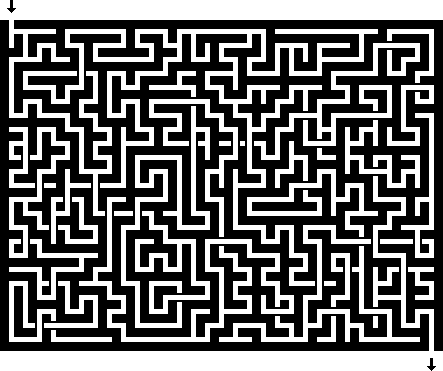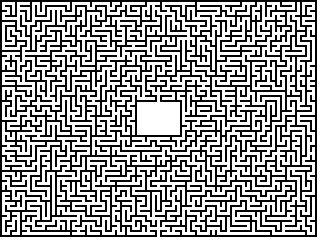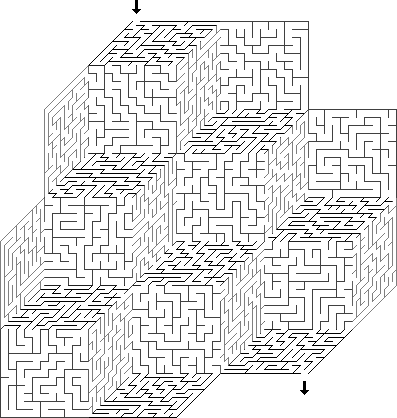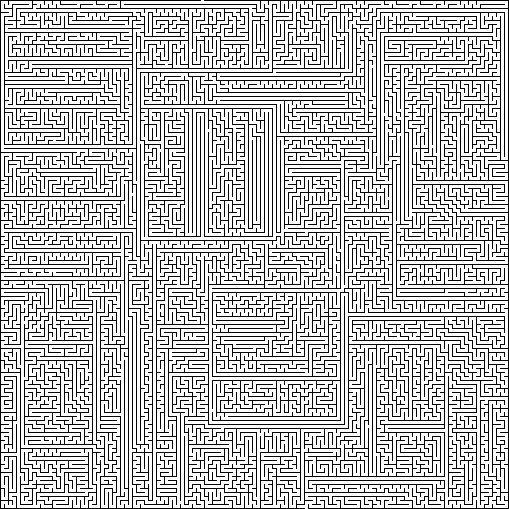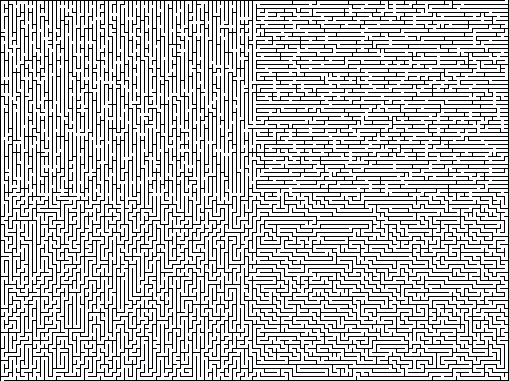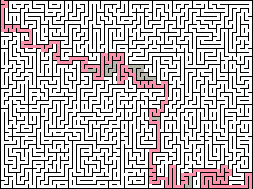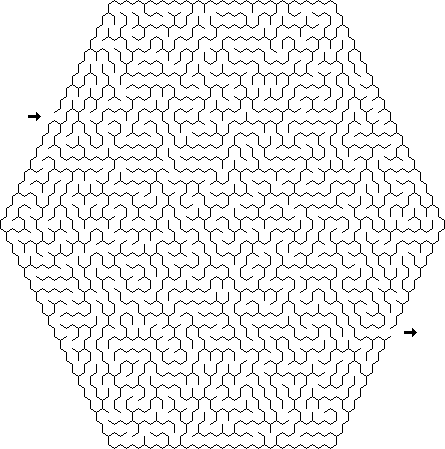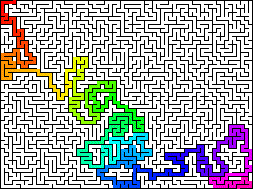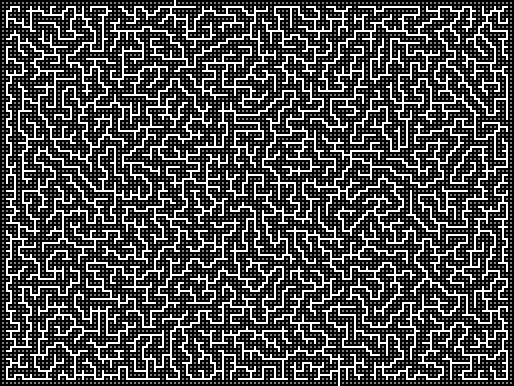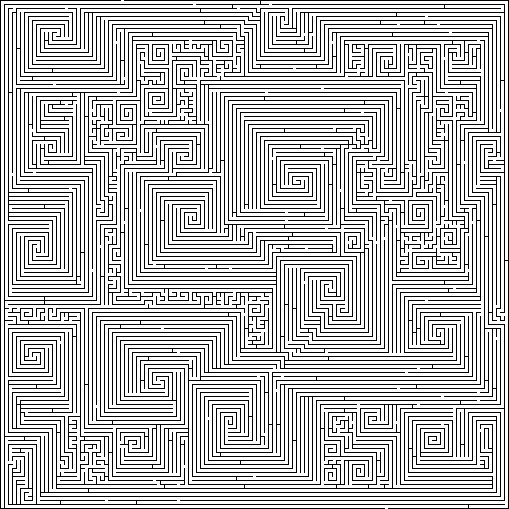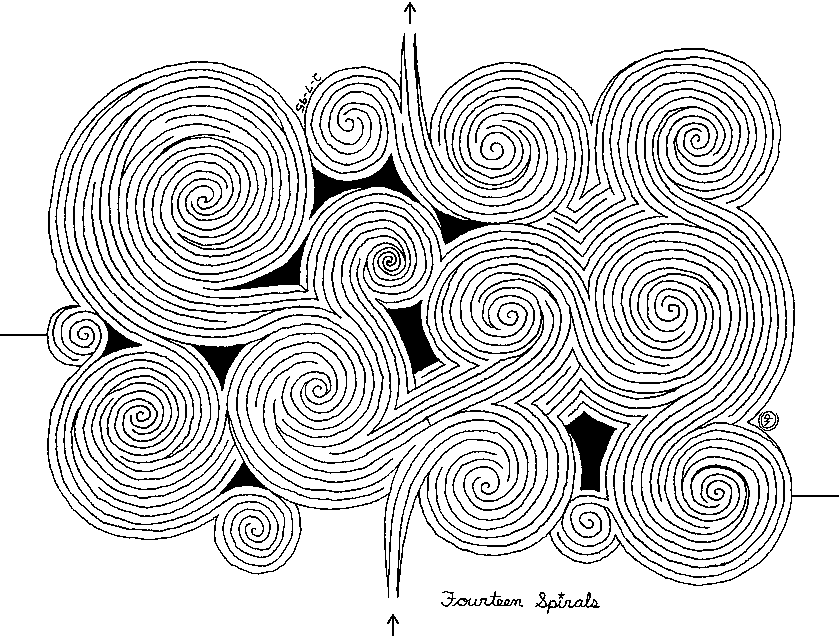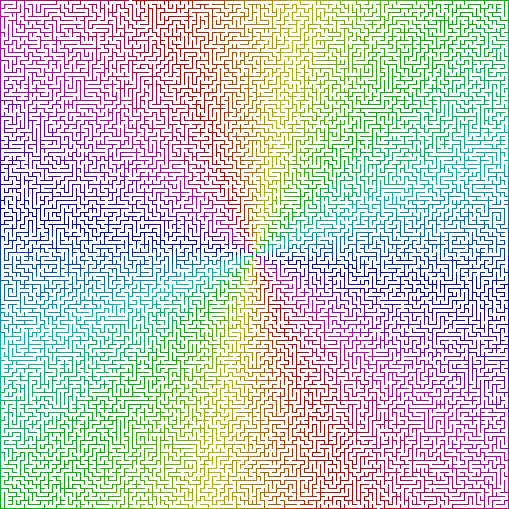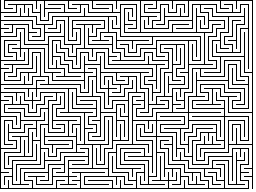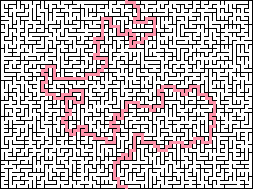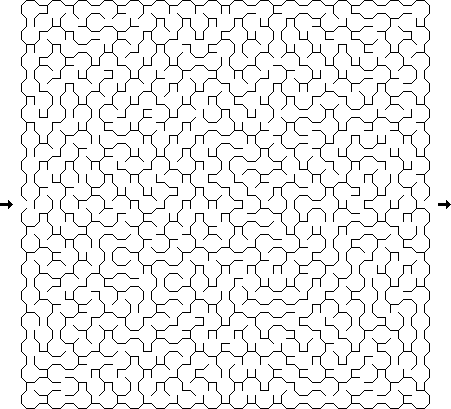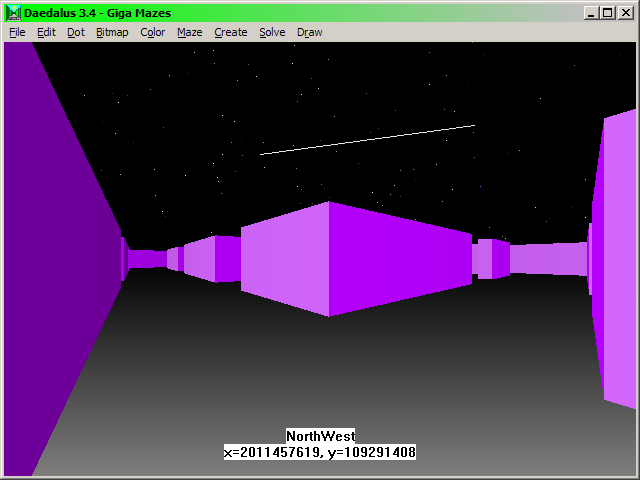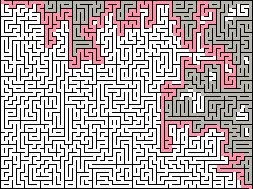
These items reference types of Mazes or things you can find or do within a
Maze. See the algorithms page for more information
about many of these terms.
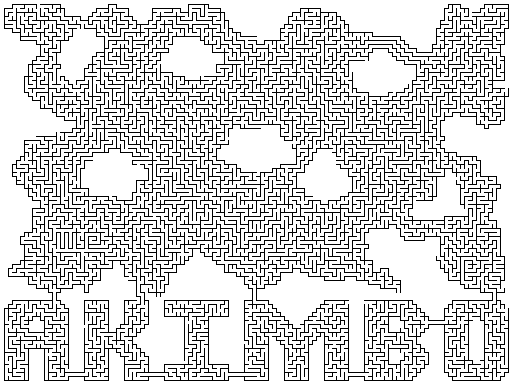
- Akimbo: The act of leaving a
Maze through a passage in the boundary wall, and then reentering the Maze
through another passage. It's possible to have a Maze that requires "going
akimbo" in order to solve it. Effectively, the area outside of the Maze is
being treated as one giant cell. Term comes from the akimbo body position which
juts out and returns inward.
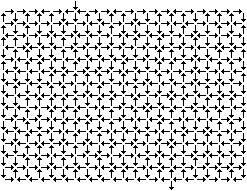
- Arrow Maze: Type of directed
Maze composed of a network of arrows, in which you can't go against the way an
arrow is pointing.
- Backtrack: The act of turning around and retracing your path in a
Maze. You can either be forced to backtrack (like when a dead end is reached)
or just choose to do so. This can refer to the actions of a person or a
computer algorithm in navigating a Maze.
- Beginning: See start.
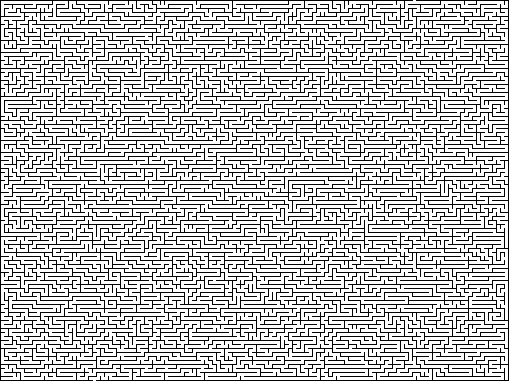
- Bias: Maze texture type
characterized by straightaway passages that tend to go along one axis more
often than at other angles. A Maze with passage bias is usually more difficult
to navigate "against the grain".
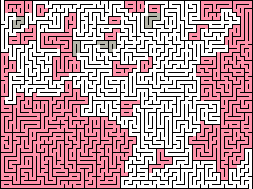
- Blackout: The act of visiting every cell in a Maze. After having
solved a Maze one may want to start exploring other passages for fun. Once
you've visited every section at least once, you've achieved blackout for that
Maze. This can refer to the actions of a person or a computer algorithm in
navigating it.
- Blind Alley: A passage
where if you walk down it in one direction, you will have to backtrack through
that path in the other direction in order to reach the goal. All dead ends are
blind alleys, as are all cul-de-sacs or any sized collection of paths connected
to the rest of the Maze by a single stem.
- Block: The wall segment at the end of a dead end that blocks your
way and forces you to backtrack.
- Bottleneck: A passage or
intersection in a Maze such that every solution to that Maze passes through it.
Sealing off any bottleneck makes a Maze unsolvable. For perfect Mazes, the
entire solution path is a bottleneck.
- Boundary Wall: A wall on the outermost perimeter of a Maze, that has
a passage on one side of it and area that is no longer part of the Maze on the
other side.
- Braid Maze: A Maze without any
dead ends. Also called a purely multiply connected Maze. Such a Maze uses
passages that coil around and run back into each other (hence the term
"braid") and cause you to spend time going in circles instead of
bumping into dead ends. A well-designed braid Maze can be much harder than a
perfect Maze of the same size.
- Cell: A point in a Maze, or more technically the passage units which
are linked in a grid or network to form the Maze. Each cell is a vertex, and
has zero or more passage edges leading away from it to other cells.
- Circuit: A passage or set of passages
in a Maze which form a ring around something. In unicursal Labyrinths a circuit
refers to one of the passages that circles the center. A Labyrinth's size can
be determined by the number of circuits or passage rings it has.
- Checkpoint: A point in a Maze you are
supposed to find before you can finish. Mazes with multiple checkpoints
sometimes require you to visit them in a certain order.
- Closed Circuit: See loop.
- Corner: Point in a Maze where a passage or wall makes a turn. This
is most commonly but not always a right angle turn.
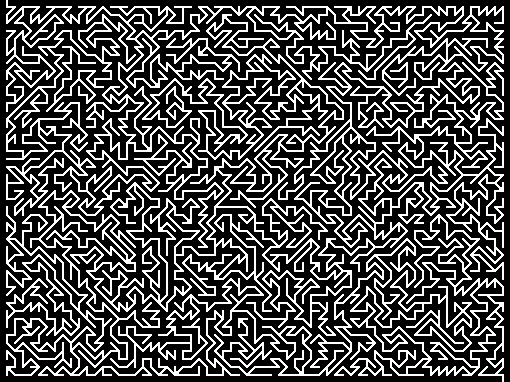
- Crack Maze: Amorphous style of
Maze that's not on any consistent grid, but rather has walls or passages at
random angles.
- Crossroads: Point in a Maze where four passages meet, or two
passages intersect, most commonly at right angles. Can also mean a general
point where four or more passages meet.
- Cul-de-sac: Construct in a
Maze consisting of a blind alley stem that has a single loop at the end, in
which that loop is a reflexive passage with no other junctions along it. Also
called a noose.
- Cyborg Maze: A Maze partially
created by hand and partially computer generated. For example, draw the
boundary walls, solution, and main false paths by hand, and let the computer
fill in the rest. Such Mazes have the personality of a hand drawn Maze,
combined with the speed of creation of a computer generated Maze.
- Dead End: A passage that has
one end terminated by a block, forcing you to backtrack, and only the other end
is connected to the rest of the Maze.
- Delta: Style of Maze composed of
interlocking triangles. Name comes from the triangle shape of the capital Greek
letter Delta. See also Omega.
- Detached Wall: A section of
walls that's disconnected from the rest of the Maze, such that there's a closed
circuit path going around it.
- Directed Maze: A Maze where
passages can only be navigated in one direction. See also arrow Maze.
- Elitist: Maze characteristic
indicating the length of the solution with respect to the size of the Maze. An
elitist Maze tends to have a short direct solution, while a non-elitist Maze
tends to have the solution wander throughout a good portion of the Maze's area.
A well designed elitist Maze can be much harder than a non-elitist one.
- End: A point or area one tries to reach when solving a Maze. Mazes
can have more than one end point, but usually don't. Also called the goal.
- Entrance: A start point in a Maze when that point is on a boundary
wall.
- Exit: An end point in a Maze when that point is on a boundary wall.
- Finish: The end of a Maze or the act of reaching the end of a Maze.
- Focus: Characteristic indicating how a Maze was created. The two
main types are passage carvers, in which you start with a solid block and carve
passages, and wall adders, in which you start with an empty area and add wall
segments.
- Fractal Maze: A Maze composed
of smaller Mazes. This can be a large Maze with other Mazes tessellated within
each cell, where the process may be repeated a number of times, called a nested
cell fractal Maze. This can also be a true fractal, where the Maze contains
copies of itself, and in effect is an infinitely large Maze, called an infinite
recursive fractal Maze.
- Gamma: Common style of Maze
composed of interlocking squares. Name comes from the horizontal and vertical
lines in the capital Greek letter Gamma. See also Omega.
- Goal: See end.
- Hypermaze: Type of Maze in which
the solving object is of a higher dimension than just a point. In a standard
non-hypermaze you move a point through whatever dimension environment, and the
path behind you forms an irregular line. In a hypermaze you move a line through
a 3D or higher dimension environment, and your path forms a surface!
- Island: See detached wall.
Can also refer to an isolation.
- Isolation: An unreachable
collection of passages completely surrounded by walls such that there exists no
path to that section from any start point.
- Junction: Point in a Maze where a passage branches or forks, i.e.
where three passages meet. Can also mean a general point where three or more
passages meet.
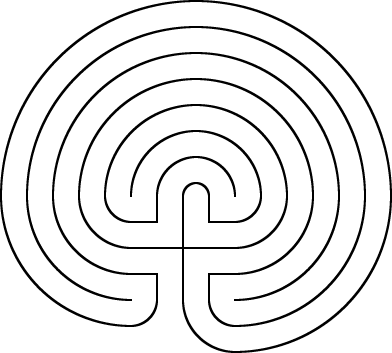
- Labyrinth: A network of
interconnected passages, usually meant to be a challenge to navigate from start
to end. Today this most often means a unicursal Maze which can be used as a
tool for meditation and spiritual growth. (There are exceptions, e.g. the
Labyrinth from Greek mythology and the Labyrinth in the movie of the same name
were both non-unicursal Maze puzzles.) Comes from the Greek word Labrys meaning
a double headed axe. See also Maze.
- Loop: A path that connects with itself
forming a circle.
- Matte: A type of template,
basically consisting of an irregular shape often meant to be something
recognizable, that a Maze is created within.
- Maze: A network of
interconnected passages meant to be a challenge to navigate from start to end.
Today this most often means a non-unicursal intellectual puzzle. (There are
exceptions, e.g. a Mizmaze is an old term for a unicursal turf Labyrinth.)
Comes from the Old English word to confuse or confound. See also Labyrinth.
- Multiply Connected: Style of
Maze that has at least one loop within it. See also Braid.
- Node: A point of interest in a Maze. A Node is usually either a
junction, dead end, room, or a point on the boundary wall, but can also be
something like a checkpoint.
- Noose: See cul-de-sac.
- Noose Junction: A junction with a reflexive passage linked to it, in
which two of the passages leading from the junction connect with each other
with no other junctions along the way. See also cul-de-sac.
- Omega: General type of Maze that
has passages on a grid that isn't orthogonal, e.g. interlocking triangles or
hexagons. Name comes from the last Greek letter. Other Greek letters signify
various styles of Omega Mazes.
- Overpass: Point in a Maze where one
passage crosses over another, but there's no way to get from one passage to the
other at that point. Overpasses are a common construct in weave Mazes.
- Passage: An individual corridor within a Maze down which one may
travel. A passage has walls on either side of it and at its ends are nodes,
i.e. either junctions, dead ends, rooms, or entrance/exit points on the
boundary wall.
- Path: A collection of passages laid end to end. The objective of a
Maze is to find a path from start to finish.
- Pattern Maze: A patterned Maze is one
whose solution is described by a pattern. If you know the secret pattern, you
can easily go through it without error, even if life sized. For example,
whenever you have a choice go left, then right, then right again, and repeat
that pattern until done.
- Perfect Maze: A Maze without
any detached walls and without any isolated sections. A perfect Maze always has
exactly one solution, and there is always exactly one unique path from any
point in the Maze to any other point in the Maze.
- Pit: See Room.
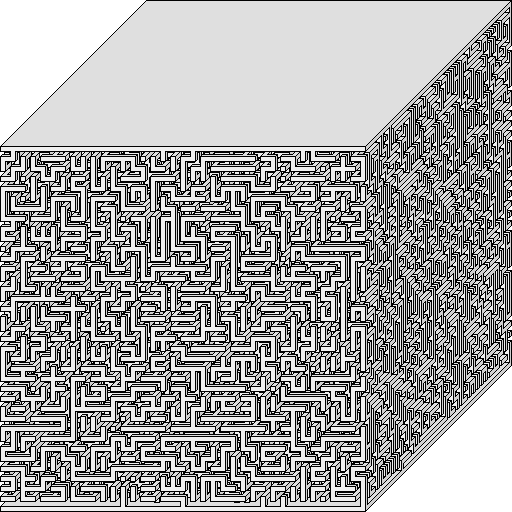
- Planair Maze: Any Maze with an
unusual topology outside of standard Euclidian space. For example, a Maze on
the surface of a cube, a Maze on the surface of a Moebius strip, or a Maze that
is equivalent to being on a torus with the left and right sides wrapping and
the top and bottom wrapping. Name is basically a shortened form of "Planes
twisted through Air".
- Reflexive Passage: A
passage with both ends at the same point. The passage loops at the ends of
cul-de-sacs are reflexive passages. A reflexive passage at a crossroads could
be considered a blind alley or cul-de-sac with a zero length stem.
- River: Maze texture type indicating the relative density of dead
ends and junctions. A Maze with a low river factor has many short dead ends,
while a Maze with a high river factor has fewer but longer dead ends.
- Room: An section of open space within
a Maze much wider than a standard passage. Rooms are sometimes used to indicate
start or finish areas. A room can technically be a large dead end, passage, or
junction depending on how many ways there are to reach it.
- Run: Maze texture type indicating
how long straightaway passages tend to go before forced turnings present
themselves. A Maze with a low passage run won't have straight passages for more
than three or four cells, and will look very random. A Maze with a high run
will have long passages going across a good percentage of the Maze, and will
look similar to a microchip.
- Rule Maze: A Maze in which there are rules defining how you can
move, e.g. where all cells have numbers and you can only go to adjacent cells
whose number is one higher. Can also refer to checkpoints or other things you
have to do while inside the Maze.
- Segment: A single section of wall between two cells. A passage
segment is a single section of passage between two cells.
- Segmented: Type of Maze that
has different sections in different styles, or gradually fades from one style
to another between two sections. For example, a Maze in two rings where the
outer ring is perfect but the inner ring is braid would be segmented, as would
a Maze which is horizontally biased at the top fading into a vertical bias by
the time one reaches the bottom.
- Shortest Path: The ultimate
form of Maze solving. A shortest path is a solution such that no other solution
path in that Maze has a shorter length. A Maze can have more than one shortest
path.
- Sigma: Style of Maze composed of
interlocking hexagons. Name comes from the shape of the capital Greek letter
Sigma, which has similar horizontal and diagonal angles seen in a hexagon. See
also Omega.
- Simply Connected: A Maze
without any loops.
- Solution: A path in a
Maze from start to finish.
- Solve: The act of finding the solution to a Maze.
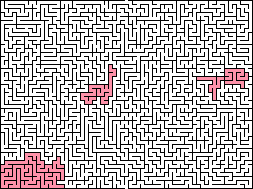
- Sparse: A Maze in which not every
cell within the boundary wall is part of the Maze. In passage carved Mazes,
this is where certain cells haven't been carved into, meaning they're solid
wall and effectively inaccessible locations.
- Spiral: A construct in a Maze
consisting of one or more passages wrapping around themselves forming a spiral.
Often the center will be a junction. Spirals can make a Maze challenging to
navigate, since it's not easy to determine what side of the spiral a passage
leading out of one will go to.
- Spiralstorm: Style of Maze
composed of interlocking spirals, especially a personal style of hand drawn
Maze I do that has this characteristic.
- Start: A point or area one begins at when solving a Maze. Mazes can
have more than one start point, but usually don't.
- Straightaway: A straight section of passage. It may or may not have
junctions along it. The endpoints of a straightaway are either dead ends,
forced corners or turns, T-junctions in which the straightaway is the stem, or
points on the boundary wall.
- Symmetric Maze: A Maze in
which the passages are symmetric, such as rotationally symmetric about the
middle some number of times, or reflected across the horizontal or vertical
axis.
- Template: A Maze template is a
general graphic that isn't a Maze, but is modified to be a valid Maze still
having the texture or look and feel of the original graphic template. For
example a Maze in the shape of a recognizable object, or a picture that's
actually a Maze if you look closely, is based on a template.
- Texture: The style of passages within a Maze. Characteristics like
bias, river, and run describe textures.
- Theta: Style of Maze composed of
passages arranged in concentric circles, where usually the start or end is in
the center. Name comes from the circular shape of the capital Greek letter
Theta. See also Omega.
- Trap: A section in a Maze that it's possible to reach, but not
backtrack from or leave in any other way, e.g. a junction in an arrow Maze
where all the arrows point at the junction.
- Tube: A passage with an open space on either side of it. Its walls
are either boundary walls or they separate the passage from a room. In other
words this is a narrow neck passing between two sections of a Maze.
- Unicursal Maze: A Maze
without any junctions, consisting of a single snake like passage from start to
finish. See also Labyrinth.
- Uniformity: Quality of a Maze
generation algorithm such that it generates all possible Mazes with equal
probability. A partially uniform algorithm can still generate all Mazes, but
not with equal probability. A non-uniform algorithm has certain Mazes that it
can never generate.
- Upsilon: Style of Maze
composed of interlocking octagons and squares. Name comes from the shape of the
capital Greek letter Upsilon, whose "Y" shape is similar to angles
seen in these Mazes. See also Omega.
- Virtual Maze: A computer
Maze which isn't stored in memory all at once, presumably because the Maze is
too large to all fit in memory. For example only store the section of passages
nearest your location, in a simulation where you walk through a giant Maze.
This can be applied to fractal Mazes to work with Mazes of infinite or near
infinite size.
- Vortex: A spiral pattern consisting of
a junction in the center where three or more passages meet. This can make Mazes
on paper and especially life size Mazes more challenging to solve, because it's
difficult to determine what part of the Maze each passage in the center leads
to without actually following it.
- Wall: A barrier in a Maze that one is not allowed to pass through
when solving the Maze. Walls can be physical constructs that actually block
your way, as in a life size hedge Maze, or just other methods of indicating
that you shouldn't pass that way, such as lines drawn on the ground or on a
sheet of paper.
- Wall Following: The act of
always keeping a wall to one side of you (either your left or right) as you go
through it. Wall following will successfully solve many but not all Mazes.
- Weave Maze: A two dimensional
Maze in which the passages are allowed to overlap each other, with bridges and
underpasses. When looking at it from above it's generally obvious what's a dead
end and what's a passage that goes under another. Life size Mazes that have
bridges connecting one portion of the Maze to another are partially weave.
- Zeta: Style of Maze on a square
grid that allows diagonal passages in addition to horizontal and vertical ones.
Name comes from the "Z" shape of the capital Greek letter Zeta. See
also Omega.
These items reference types of life size Mazes and Labyrinths used for
spiritual purposes, and things from stories that feature Mazes and Labyrinths
in them. These include the Greek myth of Theseus and the Minotaur, and the Old
English tragedy of Rosamond the Fair.
- Aegeus: King of Athens. When Androgeous was killed at the Olympics,
Minos attacked Athens and as a condition of peace forced King Aegeus to
annually submit seven youths and seven maidens to be thrust into the Labyrinth
as food for the Minotaur.
- Androgeous: Son of King Minos who was so gifted that he won all the
prizes at the Olympics, and was therefore killed out of jealousy.
- Ariadne: Daughter of King Minos. She enabled Theseus to slay the
Minotaur by giving him a clew of thread which he tied to the entrance and
unrolled as he went into the Labyrinth in order to find his way back without
becoming lost. She fell in love with Theseus and left Crete with him.
- Asterion: The Minotaur's name.
- Bower: Another term for a Maze or Labyrinth, especially a hedge
Maze.
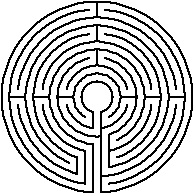
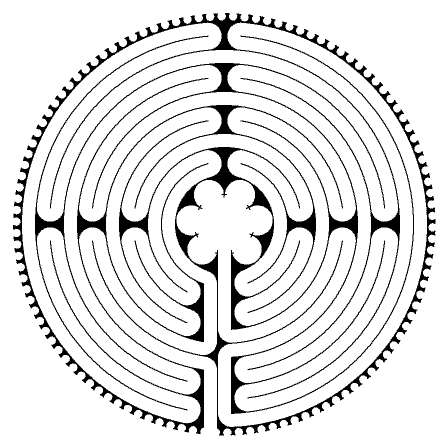
- Chartres Labyrinth: A style
of unicursal Labyrinth characterized by eleven rings and four quadrants, where
the start and end passages are close but not perfectly lined up, popularized by
a Labyrinth of this style in the floor of Chartres Cathedral in France, and
commonly walked for spiritual purposes today.
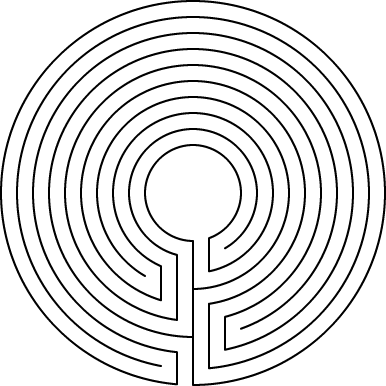
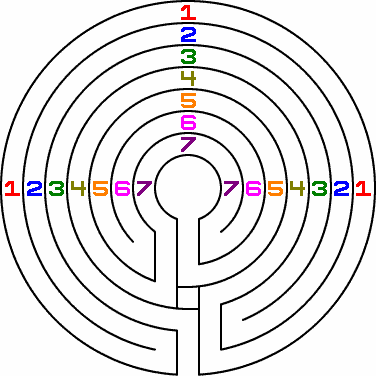
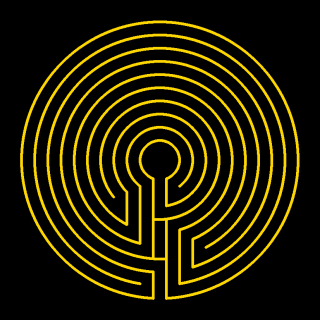
- Classical Labyrinth: A style
of unicursal Labyrinth characterized by seven rings, that's been around for
hundreds of years and has been seen in many different cultures around the
world. This is sometimes mistakenly called the Cretan Labyrinth, which is a
different pattern.
- Clew of Thread: A ball of string. Ariadne gave a clew of thread to
Theseus so he could find his way out of the Labyrinth, and Eleanor of Aquitaine
used one to solve Rosamond's Bower.
- Cosmic Labyrinth: A giant classical
seven circuit Labyrinth in the heavens indicated by the "Seven Dwarfs" or the
seven largest bodies beyond Pluto. When assigning one of the esoteric Seven Rays
to each of these seven bodies, and arranging them in order from largest to
smallest, one gets 3214765 which is the circuit sequence of the classical seven
circuit Labyrinth.
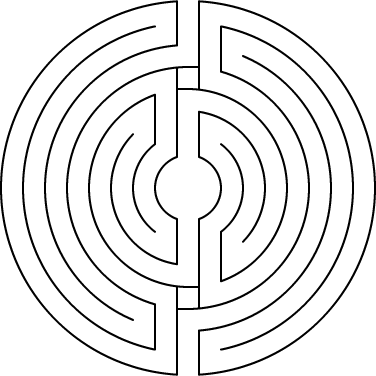
- Cretan Labyrinth: A style of
unicursal Labyrinth characterized by ten rings and four quadrants, where the
start and end passages line up.
- Daedalus: Gifted craftsman who built the Labyrinth. He also built a
hollow mechanical cow to allow Queen Pasiphae to mate with a special bull which
resulted in the birth of the Minotaur. When thrown into the Labyrinth by King
Minos, he built wings held together with wax allowing him and his son Icarus to
escape.
- Dapuritojo Potinija: Ancient Minoan goddess of the Labyrinth. Can be
considered a pre-Greek form of Ariadne.
- Eleanor of Aquitaine: Wife of King Henry II (1122?-1204). Furious
about her husband's affair with Rosamond the Fair and that he tried to hide
Rosamond from her in the Maze Rosamond's Bower, she used a clew of thread just
as Theseus did to find her way to the center whereupon she killed Rosamond.
- Handedness: Indicates the first direction one turns after entering a
unicursal Labyrinth. In a left handed Labyrinth the first turn is to the left,
and in a right handed Labyrinth the first turn is to the right.
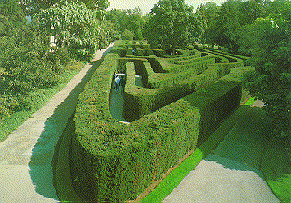
- Hedge: Type of life size Maze
where the walls are high hedges. Hedge Mazes require many years to grow and
then require continual trimming, however "living Mazes" of this type
can be considered the most beautiful and interesting.
- Icarus: Son of Daedalus, he was locked with his father in the
Labyrinth after the Minotaur was slain. Daedalus cautioned him not to fly too
close to the sun lest his wax wings melt, but Icarus didn't listen and so fell
to his death in the sea.
- King Henry II: King of England (1133-1189). As the story goes, he
built Rosamond's Bower to hide his mistress Rosamond the Fair from his wife
Eleanor of Aquitaine.
- Knossos: City on Crete containing the palace of King Minos and
presumably the Labyrinth as well.
- Labrys: Sacred double headed axe used by ancient Minoan
civilization. This is the root of the word "Labyrinth".
- Lunation: The crescent shaped
decorations around the outside of a Labyrinth, especially those around the
Chartres Cathedral style. They consist of foils (indentations) and cusps
(hourglass protrusions). The Chartres Labyrinth has 112 complete foils and 113
cusps.
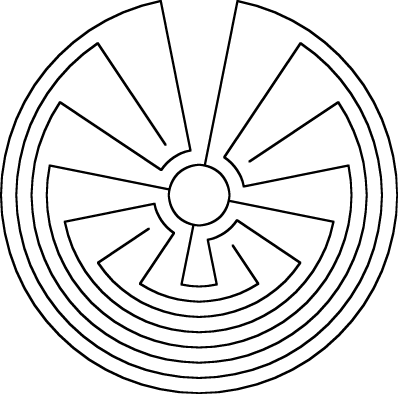
- Man in the Maze: Style of
unicursal Labyrinth topologically equivalent to the classical seven circuit
Labyrinth, commonly seen in the Tohono O'Odham nation (Native American tribe),
characterized by seven concentric circles with the seed pattern in the center.
- Minos: King of the Greek island of Crete. King Minos' pride in
refusing to sacrifice a special white bull to the gods caused them to make his
wife Pasiphae fall in love with the bull and give birth to the Minotaur. When
his son Androgeous was murdered in Athens, he forced the Athenians to give
seven youths and seven maidens every year to be thrown into the Labyrinth and
devoured by the Minotaur.
- Minotaur: Vicious monster with the body of a man and the head of a
bull, who dwelled within the Labyrinth and killed all who entered. He was the
son of Queen Pasiphae and was eventually slain by Theseus.
- Mizmaze: Old term for a Labyrinth or Maze, especially a turf
Labyrinth.
- Nemetona: Celtic goddess of Labyrinths and sacred spaces in general,
i.e. the Guardian of the Sacred Grove.
- Pasiphae: Wife of King Minos. After King Minos refused to sacrifice
a special bull to the god Poseidon, the gods made Queen Pasiphae fall madly in
love with the bull. She mated with it and as a result gave birth to the
Minotaur.
- Perfect Labyrinth: A particular
Labyrinth with circuit sequence 349852167. This Labyrinth is called "The Perfect
Labyrinth", because it's the smallest standard full circuit Labyrinth (with the
least number of circuits) without any limitations or blemishes. More
specifically, it's the smallest Labyrinth with all of the following properties:
Symmetric circuit sequence, no trivial circuits, not partitionable into smaller
Labyrinths along any axis, and mergeable or that allows the entrance and exit
passages to be aligned on the same axis.
- Processional: Type of unicursal
Labyrinth with both an entrance and an exit on the outer boundary. This allows
a sequence of people to walk through the Labyrinth, across the center if it has
one, and out another location, without anybody crossing path. It also allows
two people to race to the middle from both entrances.
- Rosamond the Fair: Mistress of King Henry II. As the story goes, she
was hidden in the center of Rosamond's Bower until Eleanor of Aquitaine solved
the Maze and gave her a choice of how to die: either drink poison or be killed
by a dagger. Rosamond chose the poison.
- Rosamond's Bower: Legendary hedge Maze constructed by King Henry II
to conceal his mistress from his jealous wife.
- Seed Pattern: A simple pattern around which a unicursal Maze can be
drawn. For example, the seed pattern for the classical seven circuit Labyrinth
is a cross with four more right angle lines in each quadrant. Connecting
adjacent endpoints all the way around this seed pattern results in the
classical Labyrinth.
- Theseus: Slayer of the Minotaur. Son of King Aegeus, he volunteered
to be one of the youths submitted to be killed by the Minotaur. Theseus fought
and killed the Minotaur instead, and ran off with King Minos' daughter Ariadne.
- Troy Town: See Mizmaze.
- Turf: Type of life size Maze carved into grass or turf, where the
walls are carved into the ground and you walk on the raised grassy area. Mazes
of this type are usually unicursal Labyrinths.
These items reference characters and landmarks from the movie Labyrinth. See
the Labyrinth movie page for many more things related
to the movie.
- Alice: A friend of Sarah's from school who asked "what's the
other half of him then" when Sarah had referred to Toby as her
half-brother. Referenced in the novel.
- Alph: One of the riddle giving guards who always told the truth or
always lied. Alph was the one on the left wearing red, and who Sarah chose to
direct her question to.
- Ambrosius: The cowardly sheepdog steed of Sir Didymus that he would
ride. Looks like an identical twin to Merlin.
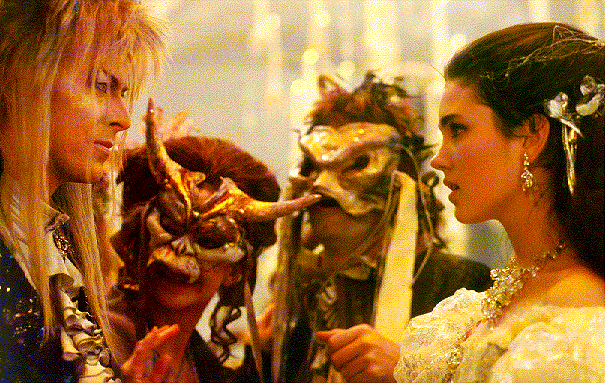
- Ballroom: The ballroom was an
enchanted place inside a bubble formed from one of Jareth's crystal balls.
Sarah entered the ballroom and danced with Jareth after she ate an enchanted
peach given to her by Hoggle.
- Beggar: Jareth disguised himself as a beggar and revealed himself in
surprise after Hoggle agreed to help Sarah solve the Labyrinth against Jareth's
wishes. In the Labyrinth computer game a beggar appears in the beginning who
presumably is Jareth as well.
- Bog of Eternal Stench: An
indescribably horribly smelling bog in the forest on the other side of the
Great Goblin Wall. If even one drop of it touches somebody, they will smell bad
for the rest of their life, as it will never wash off.
- Chilly Down: Another term for a
Firey. Also refers to the soundtrack song that plays during the Firey scene.
- Cleaners: A deadly slashing
machine with spinning blades at its front that would completely fill up a
passage and cut to bits anything it encountered. Jareth made one chase Sarah
and Hoggle after she defied him.
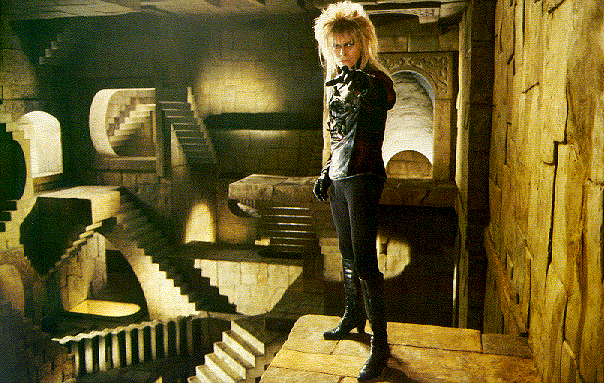
- Escher Room: Large area near
the top of Jareth's castle beyond the throne room, that had stairs and floors
and walls at various angles, and where gravity seemed to go in different
directions at different places. Based on the lithograph "Relativity"
by M.C. Escher.
- Fairy: Traditional looking
fairies could be found right outside the Labyrinth. Unlike most fairies, these
wouldn't do nice things, like granting wishes, but would rather bite you if
given a chance, as Sarah found out when trying to help one Hoggle had sprayed.
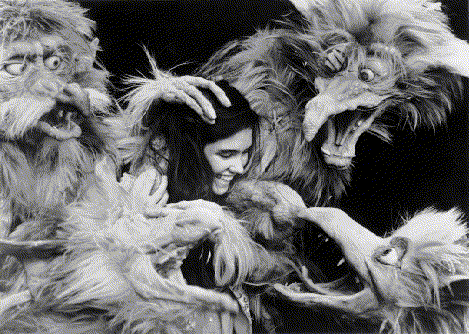
- Firey: One of the orangeish
enthusiastic creatures that lived in the forest beyond the hedge Maze and had
the ability to detach their various body parts. They just wanted to have a good
time, but their hyperactivity would obstruct Sarah and cause them to be
potentially dangerous, e.g. they wanted to cut off Sarah's head because they
could remove their own heads without ill effect.
- Forbidden Forest: The Firey inhabited section of forest inside the
hedge Maze but outside the barren section next to Jareth's castle. It was
called this in the early script.
- Four Guards: The quartet formed by Alph, Ralph, Tim, and Jim. They
were in front of two doors, one of which lead to the castle and the other which
lead to certain death. Alph and Ralph would allow you to ask one of them a
single question, where one of them always told the truth and the other always
lied.
- Freddie: In the early script
Sarah's baby brother was named Freddie instead of Toby.
- Goblin City: The town of
goblin houses surrounding Jareth's castle at the center of the Labyrinth.
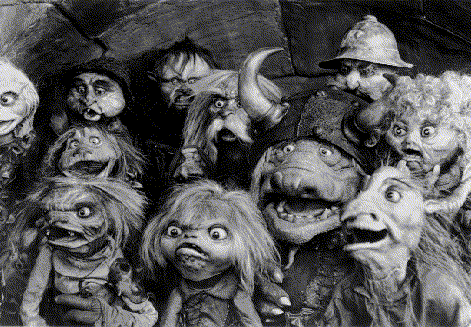
- Goblins: The numerous ugly, dumb,
short creatures ruled by Jareth. Presumably most or all of them were turned
into goblins from babies offered to him.
- Great Goblin Wall: Large stone
wall that divided the forest into two sections, with the area inhabited by the
Fireys on the outside and the Bog of Eternal Stench on the inside.
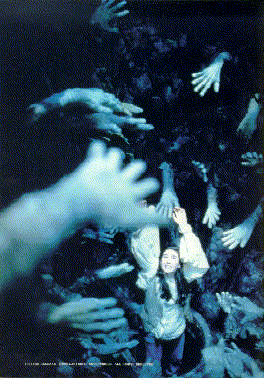
- Helping Hands: One of numerous
pairs of hands that grew out of the shaft leading to the Oubliette. They could
talk by forming faces with each other and would give a person who fell into the
shaft a choice of whether to be lifted up or dropped down.
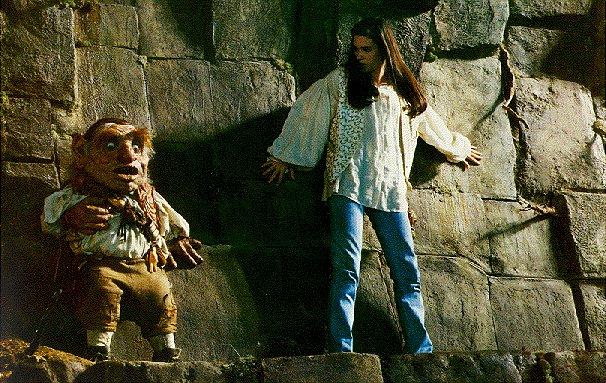
- Hoggle: Grumpy dwarf who lived
outside the Labyrinth who was Sarah's first and principal friend. He liked her
a lot although wouldn't admit it until the end. He betrayed Sarah with an
enchanted peach Jareth made him give her, but later redeemed himself by saving
her from Humongous.
- Humongous: Giant robot controlled by a small goblin inside his head,
that guarded the gates to Goblin City. He nearly killed Sarah's party until
Hoggle came and took over the controls.
- Irene Williams: Sarah's stepmother, who her father remarried after
her mother left them. Called by name in the Return to Labyrinth manga.
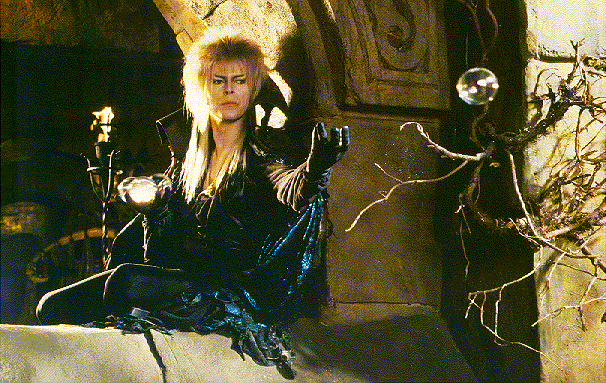
- Jareth: King of the Goblins
and principal antagonist in the story, who stole Sarah's baby brother Toby and
gave her thirteen hours to rescue him before he'd be turned into a goblin.
- Jeremy: The charming co-star and current romantic partner of Sarah's
mother. He's presumably who Sarah's mother left Sarah and her father for.
Referenced in the novel.
- Jim: The smaller upside down guard between Ralph and his shield.
- Junk Lady: Old goblin woman Sarah met after escaping the ballroom,
who tried to convince her she had everything she ever wanted in a replica of
her bedroom. In the early script the Junk Lady was actually a puppet controlled
by Jareth inside.
- Knockers: Talking door knockers that appeared on two doors in the
wall between the hedge Maze and the Firey forest. The left knocker held a ring
in his ears and was therefore deaf, while the right knocker held a ring in his
mouth and could therefore only mumble (at least until somebody took the ring
out of his mouth).
- Linda Williams: Sarah's mother, who was an actress. She walked out
on Sarah and her father, leaving him to remarry Sarah's stepmother.
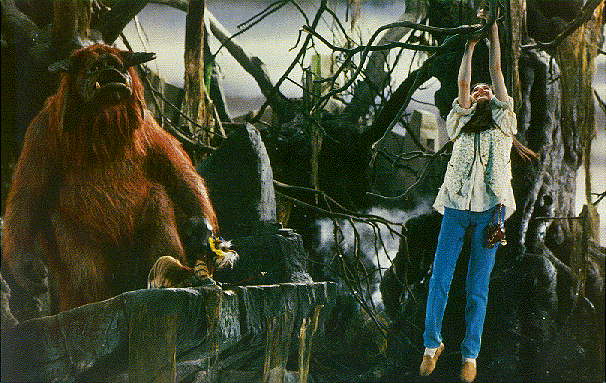
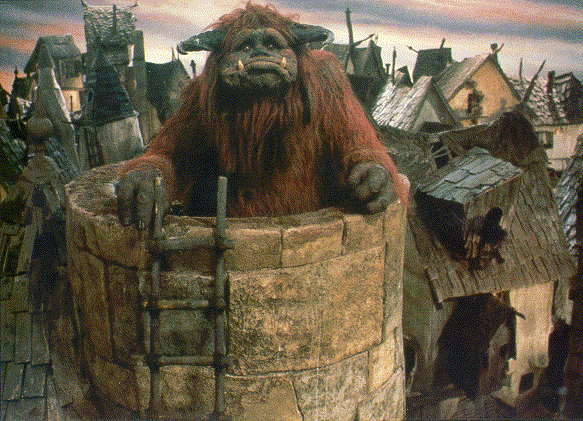
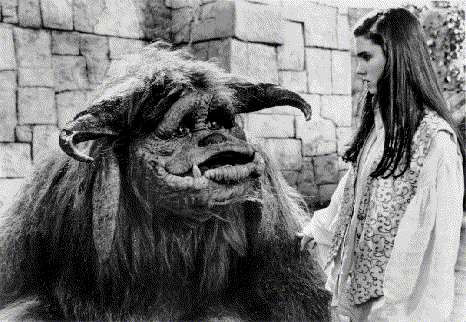
- Ludo: Giant, dumb, fearsome
looking beast with the power to summon rocks and have them do his bidding. He
was actually very sweet in nature and became Sarah's second main friend after
she rescued him from goblins and untied him from a tree.
- Merlin: Sarah's pet sheepdog. Looks like an identical twin to
Ambrosius.
- Nipper Stick: A stick with a tiny fierce creature on the end with a
big mouth that bites hard anything it comes near. Goblins used these to torment
Ludo with when he was tied to the tree.
- Oubliette: A place to put people to forget about them. Specifically
one of many traps in the Labyrinth one could fall into. They're seemingly
exitless, although at least one has a secret way out. Term comes from the
French verb oublier, to forget.
- Phony Warnings: Rock faces embedded into walls in the Labyrinth in
many places, who would give fearsome warnings not to go farther, especially
when you're on the right track.
- Ralph: One of the riddle giving guards who always told the truth or
always lied. Ralph was the one on the right wearing blue, and whose door Sarah
chose to enter.
- Robert Williams: Sarah's father, who had a generic office job.
Called by name in the novel.
- Robin Zakar: Writer of a play Sarah was practicing the lines for.
Jareth pretended to be him in order to gain access to Sarah's house while she
and Freddie were home alone. Referenced in the early script.
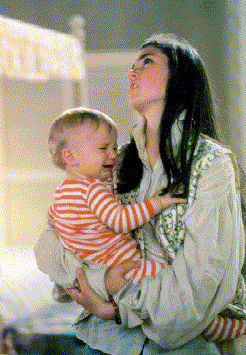
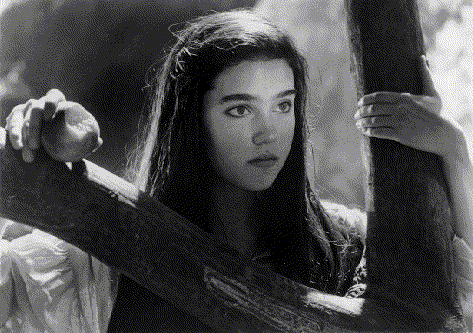
- Sarah Williams: 15 year old girl
who was the principal protagonist in the story, who wished her baby brother
would be taken away by the goblins and had to solve the Labyrinth to save him
when her wish was granted.
- Shaft of Hands: The vertical well
above the oubliette and beyond the correct door after Alph and Ralph, that had
the Helping Hands growing out of the sides.
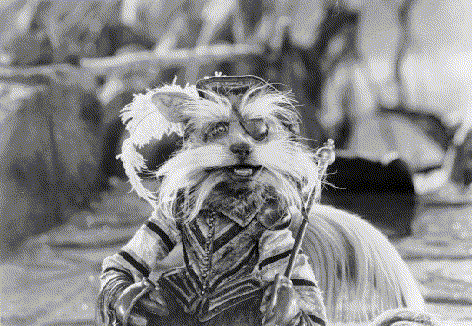
- Sir Didymus: Fearless foxlike
knight who guarded the bridge over the Bog of Eternal Stench. After Sarah and
her friends proved themselves, he became the knightly brother of Ludo and
Sarah's third main friend.
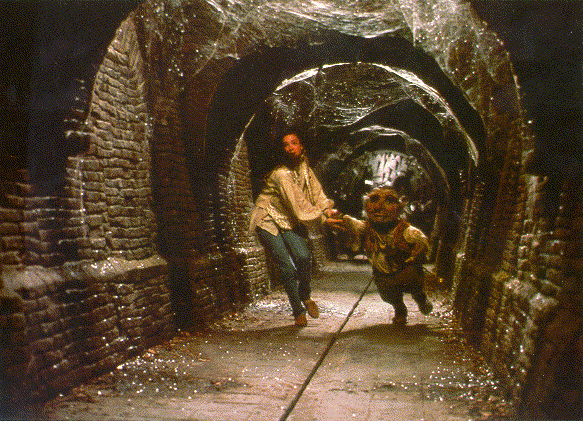
- Snatter Goblin: Little goblins that live in the Labyrinth's
brickwork. These were presumably the goblins that turned over or rotated the
paving stones that Sarah drew arrows upon using lipstick to mark her way. Name
comes from The Goblins of Labyrinth a.k.a. The Goblin Companion book.
- Tim: The smaller upside down guard between Alph and his shield.
- Toby: Sarah's baby half-brother,
the son of her father and stepmother, who Sarah had to rescue from the
Labyrinth.
- Wild Thing: Another term for a
Firey. Name comes from the early script.
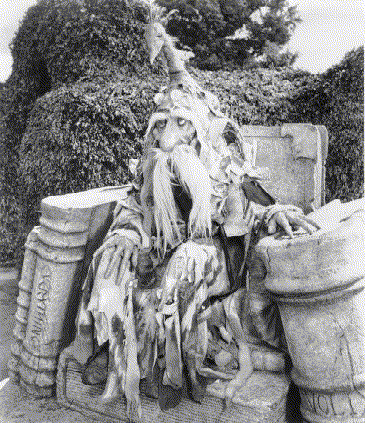
- Wiseman: A old man with a hat
topped by an unruly talkative bird. They would give cryptic advice for a
contribution. Sarah met him upon entering the hedge Maze.
- Words: The Words refer to Sarah's line that she could never remember
until the end: "You have no power over me." The Words can also refer
to the line that would summon the goblins: "I wish the goblins would come
and take you away, right now."
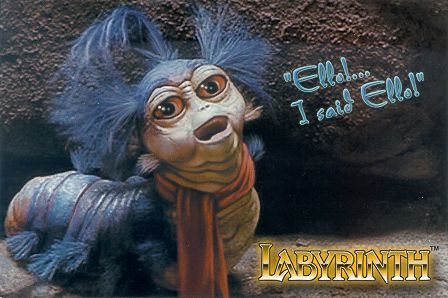
- Worm: The kindly worm was the first
character Sarah met inside the Labyrinth itself, who helped her find her way
out of the endless passageway. He kept on asking Sarah if she would like to
have a nice cup of tea and meet the "missus".
This site produced by Walter D.
Pullen (see Astrolog homepage), hosted on astrolog.org and Magitech, created using Microsoft FrontPage, page last updated
July 25, 2022.